The Trawler Captain Who Rewrote the Textbooks — Without Ever Opening One
The Man Who Knew Too Much
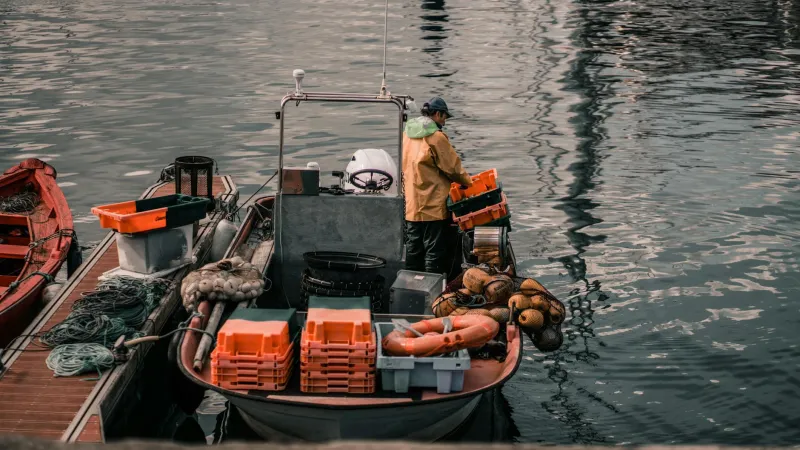
Frank Mathers couldn't tell you the Latin name for a single fish species, but he could predict their movements better than any computer model in Woods Hole. For four decades, this Cape Cod commercial fisherman kept meticulous logs that would eventually force marine biology to rewrite fundamental assumptions about Atlantic Ocean ecosystems.
 Photo: Cape Cod, via wallpaperaccess.com
 Photo: Frank Mathers, via static.dexform.com
The irony wasn't lost on anyone who knew Frank's story. He'd failed every science class he'd ever taken, dropped out of high school at sixteen, and spent his entire adult life doing what academics considered "just fishing." But while researchers were publishing papers based on controlled laboratory conditions and limited field studies, Frank was living in the laboratory itself — twelve hours a day, 250 days a year, watching the ocean's rhythms with the focused attention of someone whose livelihood depended on understanding them.
The Notebooks Nobody Believed
Starting in 1962, Frank began documenting everything he observed during his fishing runs off the Massachusetts coast. Water temperatures at different depths. Fish behavior during various weather patterns. Migration routes that seemed to shift with subtle environmental changes. Most importantly, he recorded phenomena that contradicted everything he'd been told about how marine ecosystems worked.
According to the scientific consensus, certain species shouldn't coexist in the same waters. Specific fish populations were supposed to follow predictable seasonal patterns. Deep-water species weren't supposed to venture into shallow coastal areas under normal circumstances.
Frank's logs told a different story. He documented complex symbiotic relationships between species that weren't supposed to interact. He tracked migration patterns that varied dramatically based on factors scientists hadn't considered significant. He observed deep-water fish regularly feeding in coastal shallows during specific tidal and weather combinations.
For twenty-five years, these observations remained in Frank's personal notebooks. When he occasionally mentioned his findings to marine biologists at local conferences or harbor meetings, he was politely dismissed. After all, what could a fisherman know that trained scientists with advanced degrees didn't?
When the Ocean Proved Him Right
Everything changed in 1987 during an unprecedented fish kill that devastated the Massachusetts coast. Traditional models couldn't explain the die-off patterns. Federal researchers were baffled by which species were affected and why certain areas remained unharmed while others suffered complete ecosystem collapse.
Frank's logs, however, had been predicting exactly this scenario for years. His notebooks contained detailed observations of the environmental conditions that preceded similar, smaller-scale events. More importantly, he'd documented the specific locations and species combinations that made certain areas vulnerable.
Dr. Sarah Chen, a marine biologist from the University of Massachusetts, was the first academic to take Frank's documentation seriously. What she found in his notebooks challenged decades of accepted research. Frank had been tracking environmental indicators and species interactions that formal studies had missed entirely.
 Photo: Dr. Sarah Chen, via i2-prod.mirror.co.uk
"Frank was seeing the forest while we were studying individual trees," Dr. Chen later wrote. "His perspective as someone who spent every day in the ecosystem gave him insights that laboratory-based research simply couldn't replicate."
The Advantage of Ignorance
Frank's lack of formal scientific training turned out to be his greatest asset. He wasn't constrained by existing theories or research paradigms. He didn't dismiss observations because they contradicted established science — he simply recorded what he saw.
This intellectual freedom allowed Frank to notice patterns that trained researchers might have overlooked or rationalized away. When his observations didn't match scientific predictions, he assumed the ocean was more complex than anyone realized, not that his observations were wrong.
"I never tried to make what I saw fit what I thought I knew," Frank explained years later. "I just wrote down what happened and tried to figure out why it kept happening the same way."
Recognition at Last
By the early 1990s, Frank's documentation had become essential reading for marine biologists studying Atlantic coastal ecosystems. His observations contributed to breakthrough research on climate change impacts, species adaptation, and ecosystem resilience.
Several major universities offered Frank honorary positions as a research consultant. The National Oceanic and Atmospheric Administration incorporated his historical data into their long-term environmental monitoring programs. His methodology — long-term, consistent observation combined with detailed environmental documentation — became a model for citizen science initiatives.
Frank never sought fame or academic recognition. He continued fishing until he was seventy-eight, adding to his notebooks until the day he retired. When asked about his unlikely contribution to marine science, he shrugged with characteristic understatement.
"I just paid attention," he said. "Turns out that was enough."
The Legacy of Looking
Frank Mathers died in 2018, but his influence on marine biology continues. His forty years of documentation provided researchers with an unprecedented historical record of Atlantic ecosystem changes. More importantly, his story reminded the scientific community that expertise comes in many forms, and the most important discoveries often emerge from the most unexpected places.
Today, marine biology programs across the country emphasize the importance of long-term field observation and collaboration with people who work directly in marine environments. Frank's legacy isn't just the data he collected — it's the recognition that sometimes the best scientists are the ones who never intended to become scientists at all.