She Plugged In the Wires — and Accidentally Invented the Internet, Forty Years Early
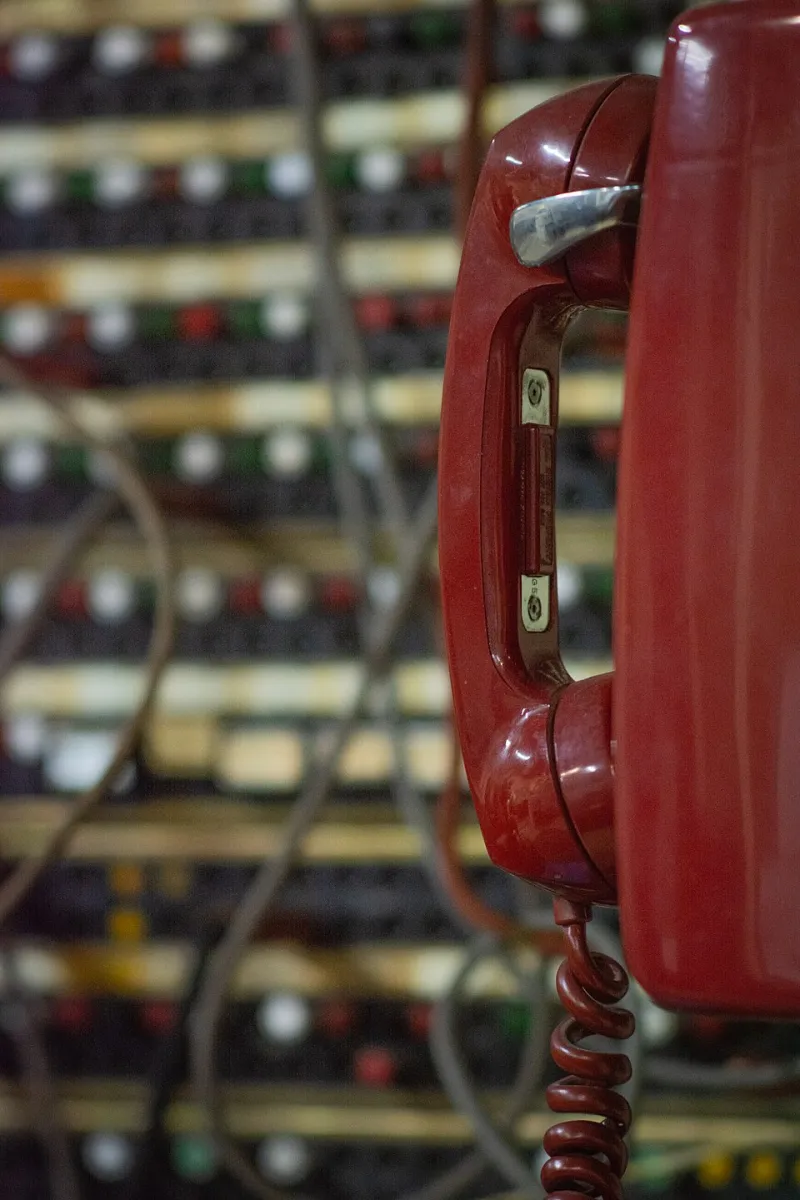
Photo: Ethan Long, CC BY-SA 2.0, via Wikimedia Commons
The Job Nobody Took Seriously
In the 1940s and 1950s, telephone switchboard operation was considered women's work — and that label was meant to diminish it. The hours were long, the pay was modest, and the cultural assumption was that plugging cables into a board required little more than nimble fingers and a polite voice.
What that assumption missed was the mind behind the hands.
Dorothy Leavitt had been working the switchboard at a mid-sized telephone exchange in Omaha, Nebraska, since she was nineteen years old. By the time she was in her late twenties, she had memorized routing patterns across hundreds of lines, could predict traffic bottlenecks before they happened, and had developed an almost instinctive feel for how information moved — where it slowed, where it jammed, and how a single reroute could free up an entire system. She wasn't just plugging in cables. She was reading the pulse of a network.
And then, one evening in 1953, her supervisor left a technical manual on the break room table. It was about early computing. Dorothy took it home.
What Engineers Couldn't See
The computing world of the early 1950s was dominated by men with engineering degrees from institutions that hadn't admitted women in meaningful numbers for very long. They were brilliant, methodical, and deeply trained in the logic of machines. But most of them had never sat at a switchboard. Most of them had never felt the living, breathing rhythm of a communications network under their hands in real time.
The core problem they were wrestling with was this: how do you get multiple computers — or multiple terminals connected to a single computer — to share information without everything collapsing into chaos? The dominant thinking was hierarchical. One machine at the top, others feeding into it, a strict chain of command. It made sense on paper. It also failed constantly in practice.
Dorothy read the manual and felt a flicker of recognition. She'd seen this problem before. Not in a textbook — at her switchboard, every single day.
Her insight, which she began sketching out in a ledger she kept in the basement of her rented house, was deceptively simple: information didn't need a single path. It needed options. A good network, she reasoned, should be able to route around a failure the same way a skilled operator rerouted a call when a line went down. The system should be distributed, not centralized. Redundant, not rigid.
She had just described packet switching — the foundational principle of the modern internet — years before the engineers who would eventually get credit for it had published a word on the subject.
A Basement, a Ledger, and Zero Credentials
Dorothy didn't have a degree. She didn't have a lab. What she had was a secondhand adding machine, a ledger book, and an almost obsessive habit of translating what she'd learned on the switchboard into diagrams that mapped how information could travel between hypothetical computing nodes.
She wrote letters. She sent her diagrams to research departments at two universities and a government contractor working on early computing infrastructure. The responses she received — when she received any — were polite and brief. One researcher wrote back to say her ideas were "interesting but impractical." Another suggested she might consider taking a course in electrical engineering before submitting further correspondence.
The irony, of course, is that the course would have taught her things she already knew. It just would have given her the language and the credentials to be taken seriously when she said them.
She kept going anyway. Through the late 1950s and into the 1960s, Dorothy refined her models, corresponded with a small network of amateur computing enthusiasts she'd found through a hobbyist newsletter, and continued working the switchboard to pay her bills. She never stopped connecting the two worlds in her mind.
The Moment Someone Finally Listened
The break came in 1961, not through a prestigious institution but through a chance encounter at a regional technology trade show in Kansas City. Dorothy had scraped together enough to attend, carrying a folder of her diagrams and a quiet confidence that years of being ignored had somehow not managed to erode.
A young researcher named Paul Hendricks, working for a small defense-adjacent computing firm, stopped at her table — she'd been allowed a small display space after talking her way past the registration desk — and spent forty-five minutes looking at her network diagrams without saying a word.
Then he said: "How long have you been working on this?"
"About eight years," Dorothy told him.
Hendricks brought her work back to his team. Within two years, elements of Dorothy's distributed routing model had been quietly folded into an internal communications project that would later feed into the research lineage that produced ARPANET — the direct ancestor of the internet as we know it.
Dorothy's name does not appear in the official histories.
What Her Story Actually Tells Us
It would be easy to frame Dorothy Leavitt's story as a simple tale of stolen credit — and there's certainly an argument to be made there. But the more fascinating dimension of her life is what it reveals about where good ideas actually come from.
The engineers working on early networking were trained to think in systems — but abstract systems, theoretical constructs built from math and physics. Dorothy had been trained by experience to think in living systems, systems that broke down and recovered, that carried human voices and human urgency, that had to work under real-world pressure every single minute.
Her so-called low-status job had given her something no classroom could: an intimate, tactile understanding of how networks behave when they're stressed. She didn't theorize about failure modes. She'd watched them happen in real time, hundreds of times, and she'd learned how to fix them with her hands.
The telephone exchange in Omaha wasn't a detour from the history of computing. For Dorothy Leavitt, it was the laboratory.
The Ones Who Don't Get the Plaque
Dorothy retired from telephone work in 1971. She lived quietly in Omaha for the rest of her life, occasionally corresponding with researchers who, in later decades, began to track down the scattered threads of early networking history and found her name in margins and footnotes.
A historian who interviewed her in 1987 asked whether she was bitter about the lack of recognition. Dorothy reportedly paused for a long moment before answering.
"The network works," she said. "That's what I was trying to do."
There are plaques in Silicon Valley. There are buildings named after men who arrived at the same destination a decade later with better funding and louder voices. Dorothy Leavitt doesn't have a plaque.
But every time a rerouted data packet finds its way around a failed node and arrives at its destination anyway, the logic she sketched out in a Nebraska basement is quietly doing its job.