She Had No Grant Money — So She Handed the Binoculars to Everyone Else
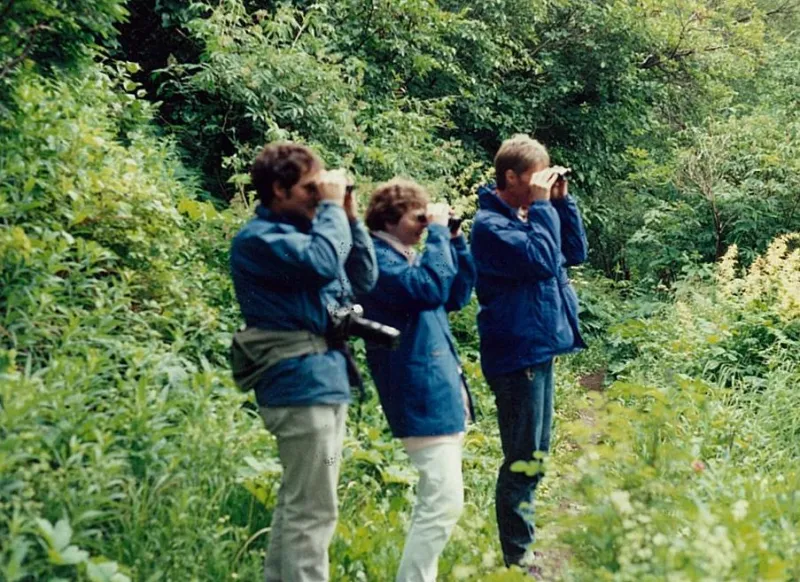
Photo: usfs_Eastern_Region, Public domain, via Wikimedia Commons
Grant rejections in academia arrive in the most politely devastating language. "While your proposal demonstrates merit..." "Given the competitive nature of this cycle..." "We encourage you to reapply..." Dr. Priya Sundaram had received enough of these letters by her mid-thirties that she could have papered a wall with them. She almost did, she jokes now. Instead she did something more useful.
She stopped trying to do the research the way the institutions wanted it done, and started doing it the way it actually needed to be done.
The Problem With Studying Birds at Scale
Ornithology — the scientific study of birds — has a scope problem that money alone can't solve. Birds don't stay put. A migratory species might move through a dozen states across three seasons, interacting with dozens of different ecosystems, responding to weather patterns, land use changes, and food availability across a range no single research team can realistically track.
Funded research programs address this through partnerships and data sharing, which helps. But they're still limited by the number of trained researchers available, the geographic areas those researchers can physically cover, and the time windows their grants fund. You end up with excellent data about specific species in specific places during specific periods — and significant gaps everywhere else.
Sundaram, whose specialty was migratory songbird populations in the central United States, kept running into those gaps. She'd build a partial picture of a population's behavior, hit the edges of what her resources allowed her to observe, and have to make do. The grants she applied for — grants that might have expanded her coverage — kept not coming through. Reviewers found her methodology sound but her scope "ambitious to the point of impracticality."
Which was, she eventually decided, exactly the problem she needed to solve differently.
Building the Network Nobody Funded
The birdwatching community in the United States is larger than most people realize. Tens of millions of Americans identify as casual or serious birders. They're in every state, every county, every habitat type. They own good binoculars. They know how to identify species. Many of them keep detailed personal records of what they see and when.
They were, Sundaram recognized, an enormous untapped research infrastructure.
The challenge wasn't recruiting them — birders are enthusiastic almost by definition. The challenge was standardization. Scientific data is only useful if it's collected consistently. A casual observation logged in a personal journal in whatever format the observer prefers doesn't combine cleanly with a thousand other casual observations logged in a thousand different ways.
So Sundaram built a protocol. Not a complicated one — she was deliberate about that, because complexity was the enemy of participation. A standardized observation form. Clear guidance on what to record, how to record it, and what counted as a reliable sighting versus a probable one. A simple online submission system she built herself with help from a friend who owed her a favor.
Then she started making phone calls. She reached out to birding clubs, Audubon Society chapters, nature centers, and state wildlife agencies. She showed up at birding festivals with a folding table and a stack of printed protocols. She gave talks at libraries and community centers and, on one memorable occasion, a Bass Pro Shops parking lot during a regional birding event.
She wasn't offering money. She wasn't offering academic credit. She was offering something that turned out to be considerably more valuable to her volunteers: the knowledge that what they were already doing mattered to science.
What Thousands of Eyes Can See
Within three years, Sundaram's network included more than four thousand active participants across seventeen states. Within five, it had grown to over twelve thousand, spanning the full migratory corridor she'd originally wanted to study.
The data that came back was extraordinary — not just in volume, but in specificity. Her citizen scientists were logging observations across time windows and geographic areas that no funded research program had ever covered continuously. They were documenting arrival and departure dates, population densities, behavioral patterns, and habitat usage at a resolution that made previous migration maps look like rough sketches.
But the most significant findings weren't the ones Sundaram had anticipated. They were the ones nobody had known to look for.
Multiple observers in different states began independently flagging anomalies in expected stopover patterns — birds arriving at traditional rest sites and moving on unusually quickly, or not appearing at all. Cross-referenced with land use data and agricultural records, the pattern pointed to a specific class of pesticide application timing that was disrupting food availability along a critical stretch of the migration route. No funded study had been designed to find that. The citizen network found it because it was watching everything, all the time.
A second unexpected finding involved a subspecies whose population had been considered stable based on existing research. The network's broader coverage revealed a localized but significant decline in a specific wintering area that smaller-scale studies had missed entirely.
Both findings resulted in published research — Sundaram as lead author, her citizen scientists acknowledged as co-contributors. Both influenced conservation policy discussions at the state and federal level.
The Science of Letting Go
What Sundaram had done, without setting out to do it, was demonstrate something that conservation biology had been slow to accept: that the expertise required to generate meaningful scientific data doesn't have to live exclusively inside institutions.
Her citizen scientists weren't doing the analytical work — that remained with Sundaram and the small academic team she eventually assembled around the project. But they were doing the observational work, and they were doing it better than any professional team could have, simply because there were more of them and they were already out there.
The model has since been replicated. Other researchers in other fields — botany, marine biology, entomology — have built similar networks, some explicitly citing Sundaram's framework. The term "citizen science" has moved from novelty to legitimate methodology in ways that would have seemed unlikely when she was getting those grant rejection letters.
Sundaram is careful to credit her volunteers. She's been known to push back firmly when journalists describe her work without mentioning them — the twelve thousand people with binoculars and notebooks who showed up, season after season, because someone asked them to and told them it mattered.
What the Funding Committees Missed
Sundaram did eventually receive significant institutional funding — after the results made ignoring her impossible. She uses it, somewhat pointedly, to expand the citizen network rather than to hire more professional researchers.
The grant rejection letters are not on her wall. She threw them away years ago. But she keeps one framed item in her office: the first observation form ever submitted to her network, filled out in careful handwriting by a retired postal worker in rural Kansas who had been watching birds in his backyard for forty years and had never imagined that anyone in a laboratory might want to know what he'd seen.
He'd been keeping records since 1987. Sundaram's protocol gave those records somewhere to go.
That, she has said, is the thing she's proudest of — not the papers, not the policy changes, not the eventual funding. The fact that a retired postal worker in Kansas found out that four decades of paying attention had been worth something all along.