Every Kitchen Slammed Its Door on Her — So She Opened Her Own, and the Neighborhood Showed Up
The last restaurant that let Darlene Okafor go did it on a Tuesday, two weeks before Christmas, in a way that she later described as "almost impressively cold." The executive chef didn't look up from his mise en place. The manager slid an envelope across the prep table. That was it. Six kitchens in three years, and every single one of them had found a reason — sometimes a real one, sometimes barely dressed-up bias — to decide she wasn't quite right for the space.
Darlene drove home to her apartment in Cleveland's Glenville neighborhood, sat at her kitchen table, and did what she always did when things fell apart: she started cooking.
A Different Kind of Credential
Darlene had grown up in a house where the kitchen was the center of everything. Her grandmother, who'd come up from Mississippi in the 1960s, ran what the family called "the table" — a rotating, informal feast that appeared every Sunday and at every imaginable occasion in between. Neighbors showed up. Extended family materialized. People who weren't technically family showed up anyway and became family through the repeated act of being fed.
Darlene absorbed all of it. The way her grandmother built flavor through patience rather than technique. The understanding that a meal wasn't a transaction — it was a conversation that happened to involve food. She carried that with her into culinary school, graduated with strong marks, and walked into the professional kitchen world with genuine confidence.
The professional kitchen world was not especially impressed.
The criticisms she received were rarely about her food. They were about her presence, her personality, the way she cooked — which was intuitive and improvisational in environments that prized rigid replication. One chef told her she was "too home-style." Another said her plating lacked "refinement." A third, more honestly, seemed to simply not know what to do with a Black woman in her mid-thirties who had opinions and wasn't going to quietly suppress them.
"After the fourth firing, I stopped trying to figure out what I was doing wrong," she said in a 2019 interview with a Cleveland food publication. "Because I didn't think I was doing anything wrong. I thought they just didn't have a category for me."
The Table as Protest
The underground supper club started almost by accident. A few weeks after that last Christmas firing, Darlene invited eight friends over for dinner and cooked the way she actually wanted to cook — no restrictions, no one else's vision, no plating conventions to follow. The food was a sprawling, generous mix of Southern tradition and West African influence, informed by her grandmother's recipes and her own decade of professional training.
People talked about it for weeks. Someone asked if she'd do it again. Then someone else asked. Then someone who wasn't even at the first dinner heard about it and asked to come to the next one.
By spring, she was hosting twice a month. By summer, there was a waiting list.
The dinners ran on a sliding-scale donation model — pay what you could, take what you needed. There were no reservations in the traditional sense. You signed up through a text chain, you showed up at the door, you sat next to strangers. The menu changed every time and was never written down in advance. Darlene cooked what felt right, what was in season, what the market had that week.
"I wasn't trying to build a business," she said. "I was trying to cook the way I was supposed to cook and see who showed up."
What Grew From the Table
What grew was substantial. By 2017, Darlene's supper club — which she'd eventually named The Long Table, a nod to her grandmother's tradition — had become a genuine institution in Glenville. She'd built a small catering arm. She'd started a weekly community meal program that partnered with a local church. She'd begun hosting pop-up dinners in partnership with neighborhood organizations for fundraisers and events.
None of it looked like a conventional food business. There was no brick-and-mortar restaurant, no Yelp page for years, no investor deck. The whole operation ran on community trust, word of mouth, and Darlene's refusal to scale faster than felt right.
That restraint turned out to be a strength. When a local restaurant group approached her about opening a formal location under the Long Table name, she negotiated terms that kept her in complete creative control and maintained the community pricing structure she'd built from the beginning. The restaurant, which opened in 2020 in a converted storefront two blocks from where she'd been hosting dinners for years, was fully booked for its first three months before it opened.
Redefining Who Gets to Be a Chef
Darlene's story has become a touchstone in conversations about gatekeeping in the culinary world — about who gets taken seriously, whose food gets labeled "elevated" versus "comfort," and what the industry loses when it keeps closing doors on people who don't fit a narrow template.
She's been profiled in food media, invited to speak at culinary conferences, and quietly consulted by a few of the same kinds of restaurants that once showed her the door. She finds that last part more amusing than ironic.
"I'm not angry at those kitchens," she said. "They did me a favor. I would have spent my whole career trying to cook like someone else. Instead, I got to figure out how to cook like me."
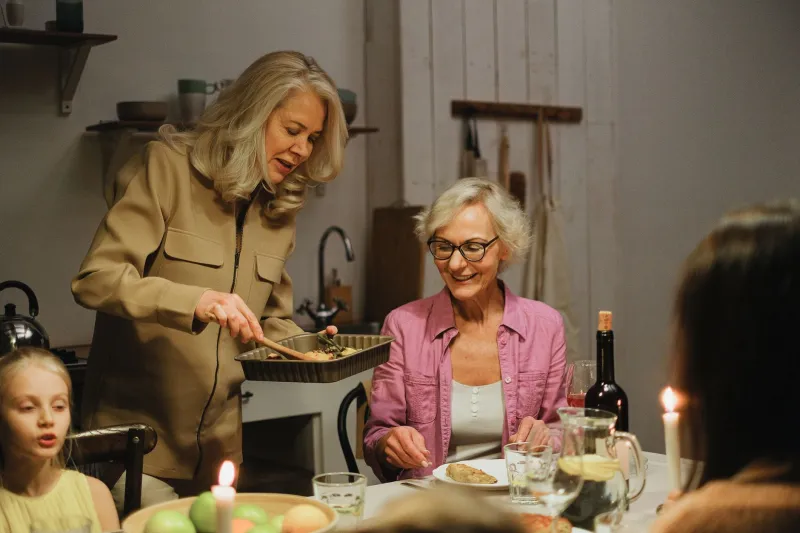
The Long Table seats forty-two people. On Sunday nights, it still feels a lot like the table her grandmother kept — neighbors, strangers, the smell of something extraordinary coming from the kitchen, and the particular warmth of a room where everyone is genuinely welcome.
Some things don't need a culinary degree to get right.