Forty Years on His Knees — and He Knew More About American Cities Than Anyone in City Hall
Ray Kowalski wasn't supposed to be in the room when the city planners unrolled their maps. He'd been called in to quote a flooring job on the third floor of a downtown Pittsburgh municipal building, and somehow — the way things sometimes happen when you've been doing something long enough to become invisible — he ended up in the middle of a heated argument between two urban engineers about what was actually underneath the block they were planning to demolish.
He waited a polite minute. Then he pointed at the map and said, quietly, "That tunnel runs the wrong direction. There's a branch that goes east, toward the old Monongahela wharf. I've seen the access hatch. It's under a storeroom on Smithfield."
The room went quiet.
The Education Nobody Assigned Him
Ray started laying carpet in 1974, fresh out of high school in western Pennsylvania. The work was physical, unglamorous, and paid decently enough to keep him from thinking too hard about other options. What he didn't expect was that the job would take him inside nearly every significant building in Pittsburgh and its surrounding boroughs over the next four decades — banks, hospitals, churches, courthouses, old department stores, converted factories, and government offices that hadn't seen a renovation crew since the Eisenhower administration.
The thing about carpet installation is that it requires you to look at the floor very, very carefully. You pull up the old material, you inspect the subfloor, and you notice things. Seams that don't match the room's dimensions. Trapdoors bolted shut and painted over. Patches of concrete that are a slightly different shade, poured over something that used to be open. Most installers noted these things and moved on. Ray wrote them down.
"I had a little notebook," he told a Pittsburgh Post-Gazette reporter in 2009. "Nothing fancy. I'd write the address, the date, what I found, what I thought it might be. It was just something to do on lunch breaks."
By 1990, he had filled eleven notebooks. By 2005, he had thirty-four.
What Was Hiding Beneath the Surface
The notebooks weren't just curiosities. Over time, they became something closer to a field survey of Pittsburgh's forgotten infrastructure. Ray had documented access points to utility tunnels that predated the city's official records. He'd sketched vault systems beneath old bank buildings that had been converted to restaurants and retail — vaults that the new owners had no idea existed. He'd noted bricked-over doorways that, when cross-referenced with 19th-century fire insurance maps he eventually started collecting, revealed entire rooms that had been sealed off during renovations and simply forgotten.
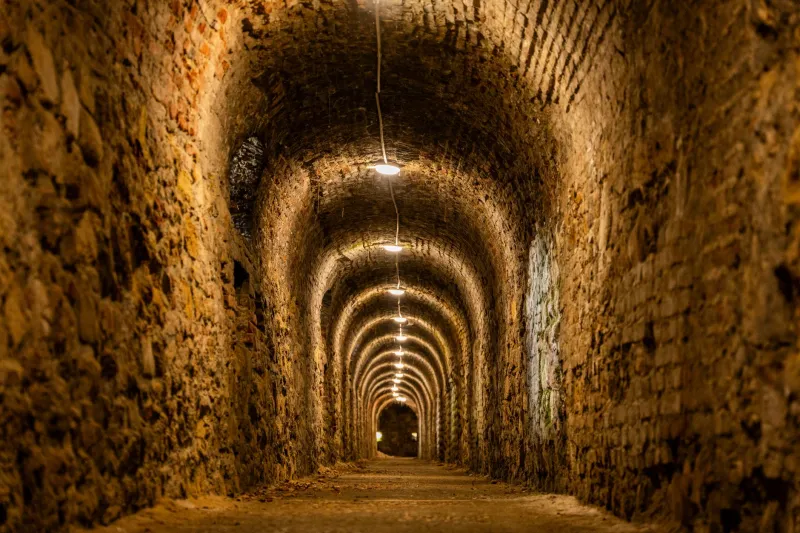
One of his most significant finds was an interconnected tunnel system running beneath a six-block stretch of the downtown strip, portions of which dated to the 1880s and had been used variously as a coal delivery network, a Prohibition-era storage corridor, and — based on some of the artifacts Ray found near access points — possibly as part of an informal route used by workers during a major steel strike in the early 1900s.
None of this was in any official record. The city's engineering department had fragments, but nobody had connected the dots. Ray had connected all of them, one stained subfloor at a time.
The Moment It Became Something More
The 2009 encounter with the planning department wasn't the first time Ray had tried to share what he knew. He'd written a letter to the Pittsburgh Historic Preservation office in 1998. He'd shown up at a neighborhood history meeting in 2003 with his notebooks and been politely thanked and quietly ignored. He was a carpet guy. What would he know?
But the tunnel he described on Smithfield Street turned out to be exactly where he said it was. The engineers found the hatch two days later. And when they started pulling on that thread, they discovered that the demolition they'd been planning would have destroyed three access points to a tunnel network that the city's own infrastructure team didn't know was still structurally intact.
The project was paused. Then redesigned. Ray was asked to come back in.
"I didn't have a degree. I didn't have a title," he said. "I had thirty-four notebooks and a good memory for subfloors."
An Unlikely Second Career
What followed was one of those strange, quietly wonderful turns that real life occasionally produces. The city brought Ray on as a paid consultant for the redevelopment project — a role that had no formal precedent in the department's structure and had to be invented more or less from scratch. He spent the next three years walking planners and historians through everything he'd documented, helping them build a comprehensive underground map that became a foundational resource for the project.
The University of Pittsburgh's urban history program eventually digitized his notebooks. A portion of the tunnel network he'd identified was preserved and incorporated into the redevelopment plan. A small section was even opened for limited public tours.
Ray kept installing carpet until he was sixty-eight. He retired in 2016, though "retired" is a loose term — he still gets calls from preservation groups and the occasional documentary filmmaker who wants to know what's under a building nobody's looked at in fifty years.
What Ordinary Work Reveals
There's a tendency to assume that expertise lives in institutions — in universities, in government agencies, in the offices of credentialed professionals. Ray Kowalski's story is a useful reminder that some of the most valuable knowledge in the world gets accumulated in the course of doing something else entirely.
Four decades on his knees, notebook in his back pocket, paying attention to things nobody told him to pay attention to. That's not a conventional path to becoming a historian. But it's a real one.
And somewhere beneath a Pittsburgh street, there's a tunnel that proves it.